- What it is: the poinciana looper, the caterpillar of a brown moth.
- Yes, it starts as a moth. The moth flies into the tree and lays its eggs on the leaves.
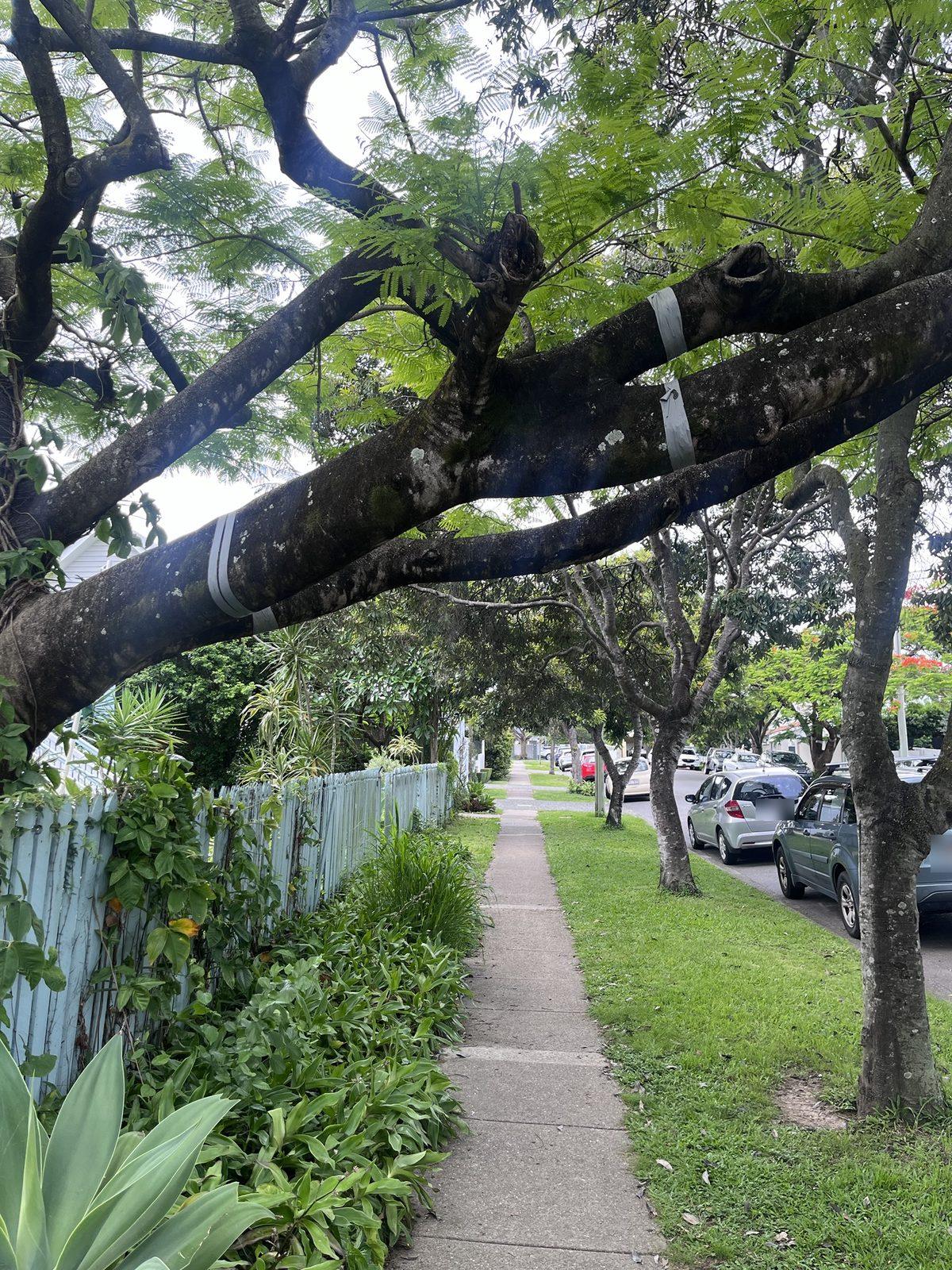
- Tree bands help, but they are not a cure. They catch caterpillars on the trunk. They can't stop a moth flying in.
- A caterpillar spray works on trees you can reach. Choose one that is safe for bees.
- Healthy trees usually grow their leaves back.
What is eating my poinciana?
The poinciana looper is the caterpillar of a moth called Pericyma cruegeri. It is long and thin, green when young, and turns a mottled brown as it grows to about 7 cm. It gets the name looper from the way it walks, arching its body into a loop with each step.
The adult is a mottled brown moth about 4 cm across. It is well established in Queensland and northern New South Wales.
The life cycle: moth first, then caterpillar
- The moth flies into the canopy and lays its eggs on the leaflets.
- The eggs hatch within a few days. Young caterpillars feed together, then spread out as they grow.
- The caterpillars strip the leaflets, leaving only the bare ribs of the leaf.
- They then form a cocoon, and a new moth emerges.
The whole cycle, from egg to moth, takes about 40 days, so one season can bring more than one wave. Numbers boom in some years and crash in others, and warm, wet weather suits them.
Will it kill my tree?
Usually not. A healthy poinciana that loses its leaves will normally put out new growth. Brisbane City Council has described these outbreaks as a natural process that doesn't cause long-term damage to the trees.
The risk is repeated attacks. A tree that is stripped again as soon as it releafs can end up with smaller leaves, dieback and poor flowering, and some arborists report losing badly hit trees the following year. A tree that is already stressed, by drought, root damage or heavy pruning, has less in reserve. So it's worth doing what you can.
Do tree bands work?
They help, and it's important to know what they can and can't do.
- What a band does: it stops caterpillars walking up the trunk. That includes caterpillars that have dropped or been blown out of the tree and are heading back up, and ones wandering over from the tree next door.
- What a band can't do: stop the moth. The moth flies straight into the canopy to lay its eggs, well above any band.
Experts are divided for exactly that reason. So think of a band as one layer of protection, not the whole answer.
Getting the best from a band
- Fit it snugly around the trunk, sticky side out, below the lowest branches.
- Check that no branches, fences or stakes touch the tree above the band and give caterpillars a bridge.
- Replace it when it is covered in insects, leaves or dust and has lost its stick.
- Rake leaf litter away from the base of the trunk.
Sprays: what to use and when
A spray only works where it lands on the leaves. That makes it a good option for young and smaller poincianas you can reach with a pump sprayer, and not much help for a tall, mature canopy. Poincianas flower through the warmer months and bees work those flowers, so the choice of spray matters.
| What it is | Bees | |
|---|---|---|
| OCP Eco Caterpillar Killer | A naturally occurring bacteria, also known as Dipel. Affects caterpillars only. For ornamental and edible plants. | Safe for bees and ladybeetles |
| Yates Success Ultra | Spinetoram. Caterpillars stop feeding straight away. For ornamentals and edibles. | Highly toxic to bees. Do not spray if bees are feeding on flowering plants. |
| Richgro Caterpillar, Grasshopper & Millipede Killer | Carbaryl. A broad insecticide for ornamentals and lawns. Not for food plants. | Broad acting, so it also affects helpful insects. Check the label. |
Our pick for poincianas is the Eco Caterpillar Killer. It only affects leaf-eating caterpillars, so the bees, ladybeetles and birds that help keep pests down are left alone. The caterpillars have to eat treated leaf, so cover the foliage well, spray when you first see them, and respray after rain.
Using the Eco Caterpillar Killer
- Mix it at the label rate: 5 g in 5 litres of water, which is half of one 10 g sachet. The rate is the same for trees, shrubs and vegetables.
- Spray both sides of the leaves as soon as you see caterpillars or fresh damage.
- Spray late in the afternoon, not in the heat of the day.
- Repeat every 5 to 7 days while caterpillars are about, and after rain.
- Be patient. It works once the caterpillars eat the sprayed leaves, so it won't stop them instantly.
Whichever you choose, read the label, mix at the stated rate, spray in the cool of the early morning or evening, and keep spray away from ponds and drains.
What else helps
- Look after the tree. Water deeply in dry spells and mulch over the root zone. A healthy tree releafs faster.
- Go easy on pruning while the tree is recovering.
- Let the birds work. Birds, wasps and other predators eat a lot of caterpillars. Broad insecticides knock them out too.
- Hose or sweep the mess. Droppings stain paving and cars, so clean up under the tree and move the car if you can.
- Check the neighbours' trees. Yellow poinciana, leopard trees, cassias and wattles can host the same caterpillar.
Big tree, or a street tree?
For a large poinciana that is being hit hard year after year, talk to a qualified arborist about treatment. Trees on the footpath belong to council, so contact Brisbane City Council about those.
Common questions
- What are the caterpillars on my poinciana tree?
- They are poinciana loopers, the caterpillars of a brown moth called Pericyma cruegeri. They are long, thin and green when young, turning mottled brown as they grow to about 7 cm.
- Do the caterpillars on poinciana trees start as moths?
- Yes. The adult moth flies into the tree and lays its eggs on the leaflets. The eggs hatch into caterpillars within a few days.
- Will caterpillars kill my poinciana tree?
- Usually not. Healthy poincianas normally grow their leaves back. Repeated attacks can cause dieback and poor flowering, especially in trees that are already stressed.
- Do sticky tree bands stop poinciana caterpillars?
- They help. A band stops caterpillars walking up the trunk, but it cannot stop the moth flying into the canopy to lay eggs. Use bands as one layer of protection.
- What spray kills poinciana caterpillars without harming bees?
- A Bt spray such as OCP Eco Caterpillar Killer, also known as Dipel, only affects leaf-eating caterpillars and is safe for bees and ladybeetles. It works on trees small enough to spray thoroughly.
General advice only. Always read the product label and follow the maker's directions and safety information. Ring (07) 3268 7161 to check what's on the shelf, or see our garden range.